What Is a Freight Elevator and When Do You Need One?
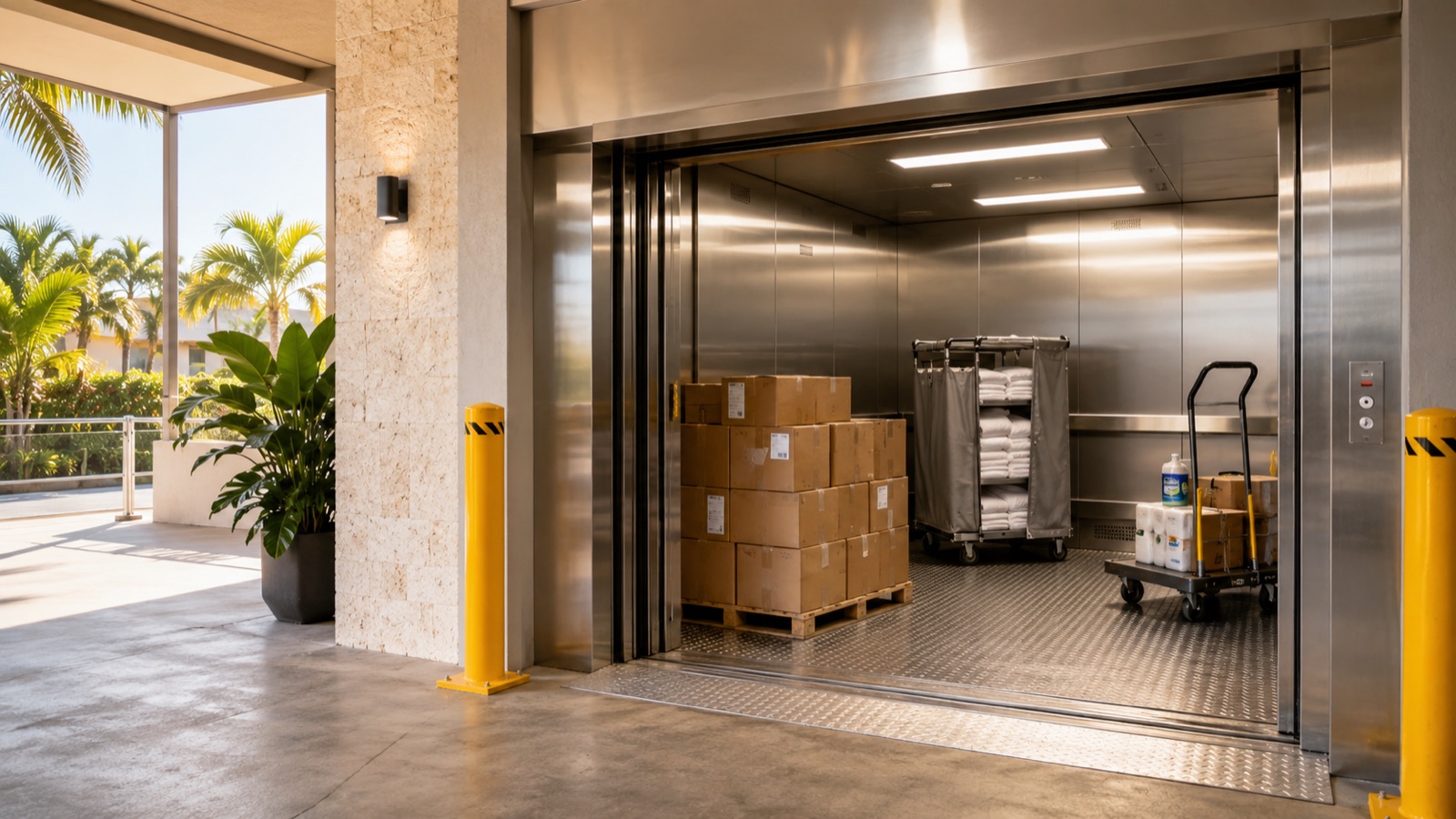
A freight elevator is designed to transport merchandise, heavy equipment, cleaning carts, trash containers, construction materials, and any type of cargo that would be inappropriate or dangerous in a passenger elevator. Unlike passenger elevators, freight elevators prioritize capacity, durability, and cabin protection over aesthetic comfort.
In Florida, freight elevators are especially common in hotels (for transporting linens and supplies), multi-story office buildings (for moves and deliveries), warehouses and distribution centers, hospitals and medical centers, and restaurants and spaces with kitchens on upper floors.
Types of Freight Elevators
1. Class A: General Cargo
The most common class. Designed for evenly distributed loads such as boxes, small pallets, and light equipment. The load is placed manually or with hand carts. Typical capacity: 2,500 to 5,000 lbs.
2. Class B: Motor Vehicle Loading
Designed to carry automobiles or trucks driven on under their own power, common in parking structures. (Powered pallet jacks and forklifts belong to Class C.)
3. Class C1, C2, and C3: Industrial Truck and Concentrated Loads
Designed for forklifts and heavy equipment. Class C1: the industrial truck (forklift) travels inside the car with the load. Class C2: the truck is used only for loading and unloading and does not travel with the car — during loading the platform may take up to 150% of rated load. Class C3: other heavy concentrated loads handled without an industrial truck. Requires reinforced cabins and high-capacity systems. Capacity: 10,000 lbs+.
4. Service Lifts/Dumbwaiters
For light loads transported without a human operator: documents, food trays, hotel luggage. Maximum capacity of 500 lbs. Ideal for restaurants, hospitals, and office buildings.
Key Differences from Passenger Elevators
- Wider doors: Freight doors typically measure 4 to 6 feet wide to allow pallets and carts to pass through.
- Cabin protection: The interior walls are lined with robust metal panels or protective rails to withstand impacts from carts and equipment.
- Reinforced floor: Built to support concentrated loads and the impact of cart and pallet jack wheels.
- Slower speed: Typically 50-100 feet per minute vs. 100-500 fpm in passenger elevators.
- Operator control: Many models have continuous-pressure controls (you must hold the button) for safety reasons.
Special Florida Regulations for Freight Elevators
The Florida Bureau of Elevator Safety enforces the ASME A17.1 code with specific requirements for freight elevators:
- Maximum capacity visible: Must be clearly indicated inside and outside the cabin.
- Passenger restrictions: In Class C elevators (forklifts), only the vehicle operator can ride in the cabin.
- Barriers and signage: Doors must have barriers that prevent the cargo from sticking out beyond the threshold during travel.
- Annual inspection: Like any elevator in Florida, requires annual state inspection.
- Registration: All freight elevators must be registered with the DBPR.
When to Modernize Your Freight Elevator
Freight elevators have a longer service life than passenger elevators (30-40 years is common), but the time comes to upgrade. Signs it's time to modernize:
- Replacement parts are no longer available or are very expensive
- More than 3-4 failures per year
- The elevator does not meet current Florida codes
- Excessive slowness affecting building operations
- Maintenance costs exceeding 50% of the modernization cost
Preventive Maintenance Tips for Freight Elevators
Freight elevators take much harder use than passenger elevators. To maximize their service life:
- Inspect protective panels monthly and replace damaged ones immediately to prevent damage to mechanical components.
- Train your staff on maximum capacity and use restrictions. Overloading is the #1 cause of premature failures.
- Inspect doors weekly: Freight doors, due to their larger size and frequency of use, are the most-worn components.
- Monitor the cabin floor: Cracks or sagging in the floor are signs of chronic overload.
- Keep the pit area clean: Oil spills, water, and debris accumulate more easily in freight elevators and can damage electrical components.